
The High Cost of Fast Fashion in 2026: From Textile Graveyards to the Regulatory Hammer
What are the High Cost of fast fashion in 2026:from Textile Garveyards to the Regulatory hammer!! what are the environmental issues in fashion industry? I am still thinking this question in 2026, In this Era can we achieve SUSTAINABLE CLOTHING minset while the Term “Fast fashion” has emerged from a retail miracle into an Environmental case study.As we are living in an era where an “Ultra-Fast” brand can be shipped at our doorsteps within 10 minutes however our wardrobes are expanding day by day and at the same time our Planet’s Resources are thinning out.The environmental impact of fast fashion is no longer hidden cost:As we are now in 2026 its a global Emergency. I want to give an example from the textile graveyards of the Atacama Desert visible from space to the microplastics found in the deepest reaches of the Mariana Trench, the “take-make-waste” model is hitting a hard wall of reality. In this definitive article, I want to explore the three pillars of this environmental crisis from fast fashion: the toxic thirst of textile or fabric production, the excessive waste, and the radical shifts in legislation and technology aimed at sewing a more sustainable future.
I am writing this blog about “The High Cost of Fast Fashion in 2026 ” because Textile industry is the world’s second-largest consumer of water, guzzling approx 93 billion cubic meters water consumption annually. which is enough to meet the thirst or demand of five million people for a year.The Life of a Single Cotton T-Shirt Think about the shirt you’re wearing. If it’s conventional or traditional cotton, it likely required 2,700 liters of fresh water to produce this product. which is equivalent of what one person drinks in 2.5 years Another impact in Asia is the Aral Sea Disaster: One of the most haunting examples of this impact is the Aral Sea in Central Asia. In past it was the world’s fourth-largest lake, now it has virtually disappeared or diminished, largely because of diverting its feeder rivers to irrigate vast cotton fields.
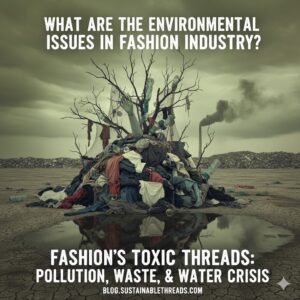
what are the environmental issues in fashion industry?
Anothe case is Pesticide Paranoia: Cotton usually occupies only 2.5% of the world’s agricultural land but it uses 16% of all insecticides and 6% of all pesticides globally. These chemicals are not just stay on the farm; they leach into groundwater, poisoning local communities.
Another bad impact for the environment is Textile dyeing which is the second-largest polluter of water globally and commomnly known as Rainbow rivers. In production or manufacturer hubs like Bangladesh, China, and Vietnam, “rainbow rivers” are a common sight—waterways that literally turn or convert the color of the season’s trendiest hue.Toxic Cocktails: Over 20,000 different chemicals are used in the industry, such as lead ,mercury t,arsenic and azo dyes.for example in China, it is estimated that approx 70% of rivers and lakes are contaminated by industrial waste and the primary contributor is the Textile Industry. Many of these chemicals are “persistent,” what I mean by this is they don’t break down; they enter the food chain and eventually reach human plates. In 2026, thanks to satellite monitoring, we can see the pollution, but what about the Marine world, the fish still can’t breathe in it.
The Waste Mountain: The second major fast fashion environmental impact is the large volume of “stuff” we throw away. In the last 15 years, clothing or garment production has doubled, while the number of times a garment is worn has plummeted by 36%. We are buying 60% more clothes as compare that we did in 2000 but keeping them for half as long.
A Garbage Truck Globally, the equivalent of one garbage truck of textiles is landfilled or burned every single second. This adds up to approx 92 million tonnes of waste per year.The Atacama Graveyard: In Chile, a massive pile of discarded or used garments or even many with their original tags still attached—has become so large that it is visible from satellite imagery. By the way ,These aren’t just “old” clothes; they are overstock and “failed” trends from the Global North dumped on the Global South.The Methane Problem: When clothes sit or stays in a landfill, they don’t just take up space. Synthetic fibers (which make up over 60% of our clothes) can take 200 years to decompose. As they release methane—a greenhouse gas which is more potent than CO2
FAST FASHION RESPONSIBLE FOR MICROPLASTIC IN HUMAN BLOOD REALLY!!
The Microplastic Menace in Your Laundry is the most insidious fast fashion environmental impact which is one you can’t see. Every time you wash a synthetic garment (polyester, nylon, acrylic), it sheds tiny plastic fibers.500,000 Tons: That is the amount of microfibers released into the ocean every year from laundry—the equivalent of 50 billion plastic bottles.
Food Chain Invasion: These microplastics are consumed by plankton, which are eaten by fish, which are eaten by… us. Recent studies in 2025 and 2026 have confirmed the presence of these fibers in human lung tissue and blood.
The Carbon Footprint: The fashion industry is responsible for 10% of global carbon emissions. If the industry were a country, it would be the sixth-largest emitter in the world, ranking just behind Japan.Polyester Most fast fashion relies on polyester, which is essentially plastic made from crude oil. It takes roughly 70 million barrels of oil each year to produce the world’s polyester.For instance, A single polyester shirt has a carbon footprint of approximately 5.5kg of CO2 compared to 2.1kg for organic cotton. When you multiply that by the billions of items produced, the numbers become astronomical.
CONCLUSION TO COMBAT THE HIGH COST OF FAST FASHION IN 2026
Now The 2026 is the era of Regulations such as EU Regulations as i discussed all laws in my blog ” FAIR-TRADE LABOR“ , Bio-Tech, and the Rise of “Slow” Fashion ,Moreover,If the above sections felt like a disaster movie, this section is the “redemption arc.” In 2026, the tide is finally turning. The fast fashion environmental impact is being met with a “Regulatory Hammer” and a “Technological Revolution.”The “End of Waste” Legislation .Governments are no longer asking brands to be “nice”; they are making it a legal requirement.The EU Ban on Destruction: As of July 2026, large companies in the European Union are legally prohibited from destroying unsold clothing and footwear. No more burning “outdated” luxury stock to protect brand value.Digital Product Passports (DPP): Starting this year, new garments in the EU must feature a digital passport. Consumers can scan a QR code to see exactly where the fabric came from, how much water was used, and—crucially—how to recycle it.EPR (Extended Producer Responsibility): Brands are now becoming financially responsible for the “end-of-life” of their products. If you make it, you pay for its disposal or recycling. This is a massive incentive for brands to design for durability longitivity rather than disposability.The Bio-Fabric Breakthrough In laboratories across the globe, we are seeing the birth of materials that don’t just “do less harm” but actually help the planet.Mushroom Leather (Mycelium): Brands are now scaling ” Organic leather” which is being grown from fungal roots in weeks, requiring a fraction of the land and water used for cattle. Carbon-Capture Sequins: New startups are creating plastic-free sequins made from captured atmospheric carbon, turning a pollutant into a fashion statement.Textile-to-Textile Recycling: For decades, “recycled” polyester usually meant old water bottles. In 2026, we are finally seeing the commercial scale of machines that can take an old poly-cotton blend shirt and segregate the fibers to create or give a high-quality new yarn.
The Psychology of “Slow Fashion”Consumers are experiencing “Trend Fatigue.” The rise of the resale market, which is growing 11 times faster than traditional retail stores, shows that “pre-loved” or used dresses is the new “premier.”Cost-Per-Wear vs. Price Tag: The conversation is shifting. A $10 shirt worn twice costs $5 per wear. A $100 ethically-made shirt worn 50 times costs $2 per wear.The “Right to Repair”: Tailoring and repair shops are seeing a resurgence as “visible mending” becomes a badge of honor among Gen Z and Alpha consumer.
As a Fashion Designer,The environmental impact of fast fashion is massive, tangled knot, but every choice we make acts as a pair of scissors. I must say we cannot shop our way out of a crisis caused by over-consumption, but we can demand a systemic shift.As we are in 2026, the mantra is simple: Buy less, choose better, and make it last. The most sustainable garment is not the one made of organic hemp or recycled ocean plastic—it’s the one already hanging in your closet and it must be Eco-friendly.