
What is Fair Trade Labor Practice? A Designer’s Guide to Fashion’s Real Foundation in 2026
Fair Trade Labor Practice in 2026!! The echoes of this term now surround everywhere ,Well I am a fashion Designer and my days are more often a whirlwind of tone and texture. A different question arises in my mind is as we usually talk about “Sustainable Fashion“ as if it’s just about organic cotton or recycled polyester. But now I’ve realized that sustainability without Fair Trade Labor Practice is like building a luxury villa on a sinkhole. As You can have the most eco-friendly or Eco-roof in the world, but without a solid human foundation, the whole thing is a lie. If the person who sewed my latest design can’t afford to put food on their table, that garment isn’t “green”—it’s exploitative. In 2026, being a designer means being a guardian of the people in my supply chain.
For me Fair trade labor in 2026 isn’t just a “nice-to-have” sticker; it’s a rigorous framework which is designed to balance the power between massive retail giants and the individual human beings in the factory.
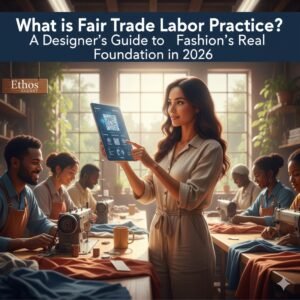
The Pillars of Fairness in textile industry :The Awareness of fair Trade Labor Practice in 2026
The Living Wage vs. Minimum Wage:
Fair Trade Labor Practice in 2026!, As we use the Anker Methodology for the calculation of wages. Of labors. Now It’s no longer enough to pay the “legal minimum” (which is often a poverty wage). A living wage must cover nutritious food, safe housing, healthcare, and education, plus a 10% safety margin.
Reasonable Hours: No more than 14-hour “forced overtime” shifts to meet a fast-fashion deadline which in turn overburdened working class labors.
The Right to Say No: Fair trade labor ensures workers have Freedom of Association—the right to form unions and negotiate their own terms without fear of being fired.
Physical Safety: Following the ghosts of Rana Plaza, fair trade mandates structural integrity audits and the total ban of toxic chemicals like certain Azo dyes that harm workers’ lungs and skin.
Why Fair Trade Matters More Than Ever in 2026
As for all of us the question arises in our mind that Why is 2026 the “Year of Accountability”? Because the law has finally caught up with the hype.
The “Regulatory Hammer”
The EU’s Corporate Sustainability Due Diligence Directive (CSDDD) is still now fully active. This law explain If a brand—even one based in the US—sells in Europe, they are legally liable for labor abuses anywhere in their supply chain. Ignoring the fair trade is no longer just a “reputation risk”; it’s a legal one.
The Rise of the Digital Product Passport (DPP)
As the Consumers in 2026 aren’t just reading labels; they’re scanning them. With a Digital Product Passport, for instance a shopper at Ethos Closet can scan a QR code and see the social score of the factory in India or Portugal where that shirt was made. Transparency is the new currency.
The Role of Fair Trade in Sustainable Clothing
Sustainability has three-legged stool thai is Environmental, Economic, and Social.
Social Justice is a Climate Justice: As we cannot protect our mother planet while exploiting its people. Workers who are paid fairly are more likely to stay at a factory long-term or till retirement, becoming experts in low-waste cutting techniques and eco-friendly machinery.
As Slow Fashion is equivalent to Safe Labor: Fast fashion that are mostly relies on “mass-output” models that create an extra pressure cooker environment. At Ethos Closet, I want to advocate for Slow Fashion, which gives factories realistic lead times. When we don’t rush the factory, they don’t have to rush the workers.
Breaking the Cycle: Common Violations Often seen in textile industry
Despite the progress in 2026, “Social Greenwashing” is still rampant. We must stay vigilant against the following Parameters.
The Subcontracting Trap: A brand only audits its main factory, but that factory quietly ships the work to a “shadow factory” with no exits or fire safety alarms.
Unpaid Overtime: Workers “clocking out” and then being forced to work another 4 hours off the books which in turn overburden and mentally harm the workers.
Child Labor: Child Labor are Often hidden in the Tier 3 and 4 levels of the supply chain (like cotton picking or spinning mills).
Case Study: The Ali Enterprises Legacy As We remember the tragic fires of the past not to be morbid, but to be motivated. These “textile graveyards” were the result of a system that valued a $5 price tag over a human life.
How to Shop Ethically in 2026 :A Checklist for Fair Trade Textile Standards
As a designer, here is my checklist for the Fair trade Textile Standard for you
Check for Certifications: Look for the Fairtrade Textile Standard, SA8000, or Fair Wear Foundation seals.
Ask for the DPP: If a brand doesn’t offer a digital trace of their supply chain, ask why.
Prioritize Natural Fibers: Fair trade often goes hand-in-hand with organic cotton and hemp because these crops protect the farmers’ health as well as the soil.
Conclusion: The Most Sustainable Garment in 2026
From my point of view Fair Trade labor in 2026 is the “social thread” that holds a garment together. At Ethos Closet, we believe that the most sustainable piece of clothing isn’t just the one made of organic hemp—it’s the one made by a person who was respected, protected, and paid fairly.
The future of fashion isn’t just about what we wear; it’s about how we treat the hands that made it.