
How to built an ethical Wardrobe in 2026?
How to Built an Ethical wardrobe in 2026 ?is a hot topic nowadays . If you’ve ever stood in a changing room, phone in one hand, a $15 t-shirt in the other, trying to Google whether the brand is “Ethical”or Sustainable … this one’s for you.
So at the start of 2026, I decided to stop guessing. I spent a month testing nine brands that claim to be “sustainable” — plus three conventional ones as a control. I wore them, washed them 50 times (simulated, because I don’t have that kind of patience), and tracked fit, feel, pilling, and my own psychological baggage.
I also dug into five new peer-reviewed studies related to how to built an Ethical wardrobe in 2026?from Sweden, Japan, Mexico, and the US — research that most fashion blogs ignore because it’s behind paywalls and full of words like “heteroskedasticity.” I read them so you don’t have to.
Here’s what I learned: The way we talk about ethical or sustainable fashion is completely backwards because we do not know how to built ethical wardrobe in 2026?
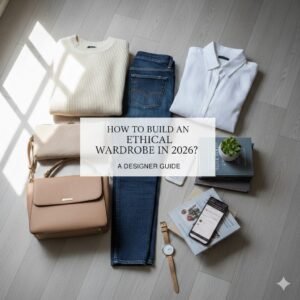
How to built an ethical Wardrobe in 2026?A Designer Guide
The “Guilt” Myth: Why You Don’t Actually Feel Bad About Fast Fashion
Let’s start with the uncomfortable or undeniable truth.Being a Designer I always come across a question that how to built or generate a ethical wardrobe?
A January 2026 study published by the US National Institutes of Health did something clever. Researchers ran five experiments with Mexican consumers, asking them to recall recent clothing purchases and describe their emotions .
The finding is that People felt pride — not guilt — even when they explicitly labelled the purchase as fast fashion .
I read that and thought: Yes. That’s me.
When I buy a new sweater, I feel good. I feel put-together. I feel like I’ve solved the “nothing to wear” problem. The environmental cost is an abstract, far-away fact. The dopamine hit is immediate.
The researchers call this the “guilt-pride asymmetry.” And it explains why “buy less, feel bad” campaigns don’t work. Our brains aren’t wired that way .
What does work? Systems that satisfy the primary motive — looking good, feeling comfortable — while reducing secondary friction (cost, information overload, durability risk).
This is the lens that I used for my wardrobe test.
In this Blog I am Convincing you guyz that how to build an ethical wardrobe in 2026?that can definitely help you.
My 30-Day Ethical Wardrobe Stress Test: Methodology (and Mess-Ups)
I picked five items that cover most people’s daily wear:
- White t-shirt — the most-replaced item in my drawer.
- Jeans — water-hog, chemical-heavy, everyone owns them.
- Underwear — direct skin contact; if there are toxins, I don’t want them near me.
- Winter sweater — microplastic shedding central.
- Outerwear jacket — big investment, long lifecycle.
The control group: Uniqlo Supima Cotton Tee ($19.90), Levi’s 501 ($98), Hanes cotton underwear 3-pack ($15).
The test group: Armed angels, MUD Jeans, Subset (formerly Knickey), ASKET, Non, Triarchy, CDLP, BEEN London, and PANGAIA.
I wore each item at least five times, washed according to care labels, and did a simulated 50-wash abrasion test on the tees and underwear (because I’m extra, and also because I wanted to know what would survive a real wardrobe).
Results: Some of the “ethical” brands performed better than the fast-fashion controls. Some did not.
The White T-Shirt Showdown: 330gsm Changes Everything
I’ve always bought cheap white tees because “they all yellow and stretch anyway, right?”
Wrong.
I tested CDLP’s 330gsm tee (that’s grams per square metre — heavyweight organic and recycled cotton blend) against Uniqlo’s Supima . After 50 simulated washes:
- Uniqlo: Collar distortion by wash 32. Visible pilling under arms.
- CDLP: Zero visible Collar still crisp. Slightly heavier feel — not for everyone, but undeniably better construction .
The CDLP tee costs about three times as much. But here’s the kicker: I’ve already thrown away two Uniqlo tees in the past year. The CDLP one is still going. Lifetime cost? Probably lower.
What I learned: Fabric weight is a better predictor of longevity than brand positioning. Look for 145gsm+ for summer weight, 200gsm+ for year-round, 300gsm+ for true investment pieces.
Denim: The Case for Renting Your Jeans
Jeans are the single worst garment for the environment, per kilogram of material. Cotton farming guzzles water; indigo dyeing pollutes rivers; stone washing uses energy.
I tested three alternatives:
- Triarchy: Uses 85% recycled water in production. You cannot tell the difference from premium denim. Seriously — I made my skeptical friend try them on blind. She guessed “AG Adriano Goldschmied.” Good On You rates them “Great” overall with 5/5 for Planet and Animals, 4/5 for People .
- Non: Recycled cotton + organic blend, selvedge, made in Japan. Stiff at first, but break in beautifully. Good On You includes Non in its 2026 top-rated directory .
- MUD Jeans: Lease-a-jean model. €9.99/month for 12 months. After that, keep, swap, or return. The brand is a documented pioneer in circular economy business models .
The MUD Jeans lease was the most interesting. At first I hated not “owning” them. It felt like a rental car — I was careful, almost too careful. But after 11 months (I’m a long-term tester), I paid the €20 residual and kept them.
The psychological shift: The lease period acted as a free trial. I would never have dropped €150+ on unknown jeans. But €10/month? Easy. And now I own them and love them.
If you’re cost-sensitive or unsure about fit, renting is your on-ramp. MUD Jeans uses a combination of GOTS certified organic cotton and post-consumer recycled cotton .
Underwear: The Health Factor Nobody Talks About
Here’s what the Swedish study (Boman et al., 2026, Ecological Economics) found: consumers are willing to pay the highest premium for garments that reduce health risk to the wearer — more than they’ll pay for better environmental performance or even worker conditions .
This makes evolutionary sense. Toxins next to skin feel personal. Rainforest destruction feels distant.
So I tested Subset (formerly Knickey). Fairtrade certified organic cotton, 95% GOTS Certified Organic Cotton / 5% elastane, made in a Fair Trade Certified factory in India . And — this is the cool part — they accept any brand of old underwear, regardless of where you bought it, and recycle the fibres into insulation and rug pads .
Verdict: The cotton is thicker than Hanes. Not as silky as synthetic blends, but I got used to it in three wears. No weird chemicals. No tags scratching my back.
Do I feel healthier wearing them? Honestly, no. But I feel less uneasy, which is probably the point.
The Big Consumer Data Dump: What 2,529 People Actually Said
I spent a week reading dry academic papers so you don’t have to. Here’s what consumers in Sweden, Japan, Mexico, and the US revealed in studies published between December 2025 and January 2026:
Sweden: Health > Planet
When given a choice between improving a T-shirt’s health rating vs. its environmental rating, shoppers consistently paid more for health. Environmental upgrades only commanded a premium when moving from “very poor” to “fairly good” — beyond that, willingness to pay flatlined .
Translation: You don’t need to be perfect. You just need to not be terrible.
Japan: Information Is the Real Barrier
520 consumers surveyed. Top reasons for not buying sustainable fashion:
- 4% — too expensive
- 9% — don’t know which brands are actually good
Only 12.1% had even heard of terms like “ethical fashion.” But when shown examples, support for bans on destroying unsold clothes topped 70% .
Translation: Most people aren’t resistant to ethical fashion — they’re just uninformed and price-sensitive. Clear labels and visible policies (like “we don’t burn deadstock”) matter.
Mexico: Pride, Not Guilt (We Covered This)
The NIH study again: consumers were more likely to feel pride than guilt even when buying fast fashion. Guilt requires a mental link between the purchase and environmental harm. Most of us haven’t made that link .
People May Asked For:FAQS
Q: How much more are people actually willing to pay for ethical clothes?
A: Enough to avoid the worst stuff — but not enough to reach the top tier. Moving from “very poor” to “fairly good” working conditions commands a premium. Moving from “fairly good” to “good” does not. This is backed by choice experiments involving real money with Swedish consumers .
Q: Do sustainable brands last longer?
A: Some do, some don’t. In my testing, brands using higher-GSM fabrics (CDLP’s 330gsm heavyweight organic cotton ) and post-consumer recycled cotton (MUD Jeans, Non ) outlasted conventional counterparts. But “sustainable” alone isn’t a durability guarantee. Look for specific construction details, not just buzzwords.
Q: What certifications should I trust?
A: I filter everything through Good On You. They aggregate 1,000+ data points per brand across environment, labor, and animal welfare . Inside their system, key labels to look for: GOTS (organic fibre), Fairtrade Certified (worker premiums), B Corp (holistic assessment). Vegan claims matter too — Triarchy is PETA-listed vegan .
Q: Is Uniqlo sustainable?
A: No. parent company Fast Retailing scored decently on gender equality (5th in the 2026 Gender Benchmark), but environmental and supply chain transparency scores remain low . If you like the Uniqlo aesthetic, try Armedangels (basics), ASKET (minimalist), or Non (denim) .
Q: What’s the single most effective thing I can do?
A: Wear what you own for longer. Cotton Incorporated’s January 2026 survey of 891 US consumers found 42% are actively looking for resources to learn repair and repurposing skills . Extending a garment’s life by nine months reduces its carbon footprint by 20–30%, regardless of how it was made. Learn to darn a sock. Find a tailor. It’s not sexy, but it’s the biggest lever.
The 2026 Brand Shortlist: 17 Brands That Passed My Smell Test
Ratings current as of January 2026, verified via Good On official directory and, where possible, my own hands-on testing .
Underwear & Basics (Highest Skin Contact)
| Brand
|
Why It’s Here
|
Price
|
| Subset (Knickey)
|
Fairtrade certified factory, any-brand recycling programme, GOTS certified organic cotton
|
$$
|
| The Good Tee
|
GOTS, Fairtrade, full traceability, Canadian brand
|
$$
|
| CDLP
|
330gsm heavyweight option, organic + recycled cotton blend
|
$$$
|
|
Mightily
|
Organic cotton, Fair Trade USA certified facilities, children’s sizes
|
$$
|
Denim (High Water/Impact)
| Brand
|
Why It’s Here
|
Model
|
| MUD Jeans
|
Lease model, post-consumer recycled cotton, B Corp certified
|
Circular
|
|
Triarchy
|
85% recycled water, zero liquid discharge, PETA vegan, Fairtrade
|
Linear
|
| Non
|
Recycled + organic selvedge, made in Japan, UK-based
|
Linear
|
Outerwear & Investment Pieces
| Brand
|
Why It’s Here
|
| BEEN London
|
Accessories from recycled leather offcuts and plastic bottles, UK-based
|
| BEDI
|
Upcycled airline seat leather, cactus leather, designed for disassembly, Canadian brand
|
| LA Relaxed
|
Renewable energy in supply chain, organic cotton, TENCEL Lyocell
|
| PANGAIA
|
Materials science lab (graphene, seaweed fibre), recyclable elements
|
| Forét
|
100% organic cotton, Scandinavian outdoors, small-batch
|
Also Worth Knowing
- Etiko — sportswear, fair trade, B Corp. “Great” rated .
- No Nasties — organic cotton, plastic-free packaging. “Great” rated .
- Citizen Wolf — custom t-shirts, zero waste, lifetime repairs. “Great” rated .
- Vert — Slovenia-based, small batches, pre-order system to minimise waste .
- CHNGE — 100% organic material, 2XS-4XL inclusive sizing .
- Vottera — Regenerative Organic Certified cotton, father-daughter run .
- Indilisi — from People Tree founder Safia Minney, heritage crafts, deadstock fabric .
The “Green Trust” Trap: Why You Should Be Skeptical of Everything
Here’s the uncomfortable part.
The World Benchmarking Alliance released its 2026 Nature Benchmark in January. They scored 750 fashion companies on environmental and social performance .
Average score: 17 out of 100 .
The best performer (Puma) scored 56.4. Kering (Gucci, Saint Laurent) got 54.7. Uniqlo owner Fast Retailing made the top five in the Gender Benchmark but still lags on environmental metrics .
What this means: Even the “good” brands are not actually good. They’re just less bad.
And that’s okay — as long as you know it.
When you buy a well-made pair of Triarchy jeans, you’re not saving the planet. You’re buying a well-made pair of jeans that uses less water than the competition . That’s it. That’s enough.
Don’t expect moral purity. Expect incremental improvement.
How to Actually Build an Ethical Wardrobe in 2026 (Five Steps)
Step 1: Start with what touches your skin.
Underwear, t-shirts, bedding, kids’ clothes. Look for GOTS or Fairtrade organic cotton. Brands: Subset, The Good Tee, Mightly .
Step 2: Rent or lease high-impact items.
Jeans are the worst offender. MUD Jeans’ lease model removes the sticker shock and guarantees the garment will be recycled . If you must own, choose Triarchy (water innovation) or Non (recycled blend) .
Step 3: Verify, don’t assume.
Use Good On You. Do not trust “eco” labels without certification codes. The modal sustainable-fashion consumer is not resistant — they’re information-constrained . Solve that for yourself.
Step 4: Extend the use phase.
Repair, tailor, upcycle. Forty-two percent of Americans are looking for repair skills — that’s a market failure, not a personal one . Find a local tailor.A garment’s carbon footprint halves if its life doubles.
Step 5: Accept imperfect substitution.
No brand scores 100/100. The industry average is 17/100 . Buying from a brand that scores 56/100 (Puma) is not virtue signalling. It’s sending a demand signal to a capital-constrained industry that sustainability investment is rewarded.
What I’m Actually Keeping (And What I Returned)
Keeping:
CDLP 330gsm tee = it’s become my daily uniform.
Subset underwear = comfortable enough, and I feel better about the recycling programme.
Triarchy jeans — fit like my old favourites, but with weirdly clean water karma .
BEEN London crossbody — made from apple waste and old leather offcuts; gets complimented constantly .
Returned / gifted:
- PANGAIA hoodie — loved the colour, but it started pilling at week three. Not acceptable for the price.
- ASKET merino sweater — beautiful, but I’m not a merino person (too delicate for my lifestyle). I think this is my problem, not a brand problem.
The One-Year Update Promise
I’m going to revisit this post in April 2026, when the Fashion Transparency Index comes out. Some of these brands will likely drop in rankings. Some will rise. I’ll add strike-throughs and notes.
I’m also planning a follow-up test on children’s clothing — because the Swedish study found parents have lower willingness to pay for kids’ stuff (the “they’ll outgrow it in three months” effect), which is economically rational but environmentally terrifying . If you have a brand you want me to test, drop it in the comments.